

How Bond Duration Works: A Beginner’s Overview to Duration & Formula
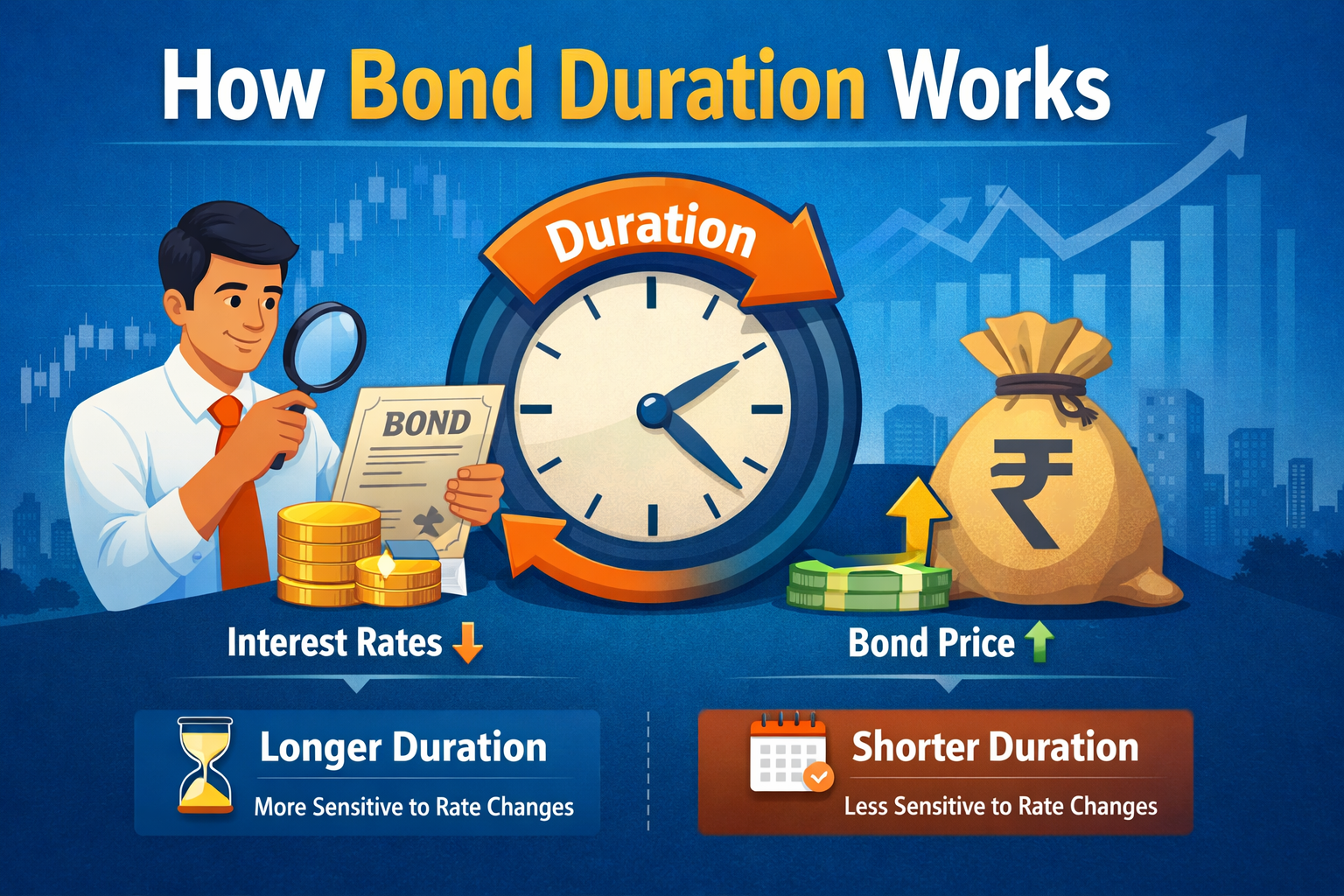
Consider an individual investor evaluating bonds, taking into account interest rates, payment schedules, and maturity dates. Even when these align with their plan, bond duration becomes crucial. A bond represents a loan to an issuer, with the face value repaid at maturity and fixed coupon payments along the way. Duration in bonds measures how sensitive a bond’s price is to market interest rate changes.
By examining how bond duration works, investors can anticipate potential price fluctuations under different interest rate scenarios, helping them make better choices about bonds without relying on predictions.
What Is Bond Duration?
When comparing two bonds with similar interest rates, you may notice that one seems to fluctuate more in value when interest rates change. This difference is explained by the concept of bond duration.
Duration measures the average time it takes for an investor to receive all cash flows from a bond, including both interest payments and the return of principal. It does not alter the payments promised by the bond, but it provides insight into how the bond’s price may react to changes in interest rates.
Bonds with higher duration tend to experience larger price changes when rates move, while bonds with lower duration usually show smaller fluctuations. By considering duration alongside interest rate and maturity, investors can gain a clearer picture of a bond’s potential price sensitivity.
Bond Duration Formula Explained
Understanding how long your money stays tied up in a bond can feel complex, but bond duration gives you a clear perspective.
Bond duration formula explained:
Bond Duration = (Sum of (Cash Flow × Time of Receipt)) ÷ Current Bond Price
- Each interest payment is taken into account
- Each payment is adjusted for the time it is received
- All values are combined into a single measure
- The formula translates multiple future payments into a simple figure
The key insight comes from what the number reveals about interest rate sensitivity, rather than from the calculation itself.
Why Duration in Bonds Matters?
Even if a bond is held primarily for regular income, the concept of duration in bonds plays a vital role in anticipating how market changes might affect its value. Duration essentially reflects the sensitivity of a bond’s price to shifts in interest rates, providing a clearer picture of potential price movements.
Here are key points to consider:
- Price sensitivity varies with duration: Bonds with longer duration tend to experience more noticeable price changes when interest rates fluctuate, while those with shorter duration typically show steadier price movements.
- Alignment with market conditions: Duration offers insight into how quickly a bond’s market value may adjust in response to changing rates, helping to set realistic expectations for returns.
- Risk perspective: A longer duration does not inherently mean a higher risk, nor does a shorter duration guarantee stability. It simply indicates the degree of price movement relative to changes in interest rates.
- Strategic positioning: Knowing the duration allows a clearer assessment of how a particular bond fits within a broader investment approach, without the need for frequent reactionary decisions.
Understanding bond duration makes it easier to anticipate market behaviour and align bond choices with personal comfort levels. This awareness supports a more measured approach to holding bonds, ensuring readiness rather than reaction when interest rates shift.
How Bond Duration Works?
When investing in bonds, it is important to know how bond duration works and why it matters for your portfolio.
- An investor may compare two bonds maturing around the same time: one pays higher, more regular interest, while the other pays lower, more irregular interest and returns most of its value at maturity.
- Even if both bonds mature on similar dates, their duration can be very different.
- Bonds that return more cash earlier generally have lower duration, while bonds that return more value later generally have higher duration.
- Duration considers both the timing and the size of payments, not just the maturity date.
- Understanding bond duration helps investors anticipate price fluctuations, manage interest-rate exposure, and align investments with their risk preferences.
By keeping these points in mind, investors can see clearly how bond duration affects the value of their holdings over time.
Bond Duration and Interest Rate Changes
Some bond prices fluctuate more than others when interest rates change. This variation is explained by bond duration. When rates rise or fall, bond prices move in the opposite direction. Duration measures how sensitive a bond’s price is to these changes.
- Longer duration → Higher price sensitivity
- Shorter duration → Lower price sensitivity
This relationship is purely mathematical, reflecting market mechanics rather than speculation.
Types of Bond Duration That You Know
When investing in bonds, knowing how long it takes to get your money back and how sensitive your investment is to interest rate changes can make a big difference. Bond duration helps you grasp both of these aspects.
- Macaulay Duration: Macaulay duration calculates the weighted average time it takes for an investor to receive all the cash flows from a bond, based on their present value. It is mainly concerned with timing rather than how the bond’s price might move.
- Modified Duration: Modified duration builds on Macaulay duration to estimate how much a bond’s price could change in response to changes in interest rates. Investors use it to understand the sensitivity of bond prices to market movements.
Both Macaulay and modified duration provide investors with useful insights into how bonds behave. One focuses on the timing of cash flows, while the other helps anticipate price changes when interest rates shift.
Duration Compared Across Different Bonds
When comparing government bonds and corporate bonds, you may find that duration varies even if the maturity seems similar. This is because the way payments are structured, their frequency, and timing all differ.
For example, bonds that pay interest more often tend to have a shorter duration, while bonds with larger payments closer to maturity usually have a longer duration.
These variations are purely factual and help provide a clearer picture when looking at different bonds. At Bondbazaar, with over 10,000 bonds across Government Securities, Corporate Bonds, and other categories, you can explore a wide range and make comparisons that suit your portfolio.
Understanding duration enables more informed bond selection, making it easier to find the right combination of risk and return for your needs.
Using Bond Duration While Building a Bond Portfolio
When building a bond portfolio for fixed income, the goal is often to strike a balance rather than go to extremes. Duration can be really useful in this process. It helps with:
- Aligning bonds with your expected holding periods
- Maintaining stability across different interest rate cycles
- Combining bonds with varying sensitivity to interest rate changes
Duration works best when considered alongside other bond features, giving you a more complete view of your portfolio’s risk and return.
Understanding The Difference Between Duration and Holding Period
Cash flow timing and interest rate sensitivity are key factors in bond evaluation.
- Duration: Duration quantifies how a bond’s cash flows are distributed over time and how sensitive its price is to changes in interest rates. A higher duration indicates greater price fluctuations when rates move.
- Holding Period: The actual length of time a bond is held before being sold or redeemed. It is flexible and not dictated by duration. Bonds can be sold at any point, independent of their calculated duration.
Recognising that duration and holding period serve different purposes clarifies bond price movements and risk management, helping avoid common misconceptions.
Where Duration Fits in the Bond Selection Process
When choosing bonds, several factors come into play, including interest rates, payment schedules, issuer profiles, and liquidity. Duration is an important consideration that complements these factors.
Here’s where duration comes in:
- It measures a bond’s sensitivity to interest rate movements, helping investors gauge potential price swings.
- It complements other metrics like yield and credit quality, providing a fuller picture of risk.
- It helps match bonds to investment horizons, ensuring your portfolio aligns with your financial goals.
- It helps balance a portfolio, especially when diversifying across short and long-term bonds.
Duration doesn’t replace other considerations, but adds a crucial layer of insight when selecting bonds.
Conclusion
Bond duration offers a clear measure of a bond’s sensitivity to interest rate changes, reflecting both the timing and size of its cash flows. This insight enables investors to compare bonds with differing structures and make better portfolio decisions. Bondbazaar enhances this process by providing a platform where users can not only buy but also sell bonds with a single click, ensuring liquidity and flexibility.
By combining expert guidance with a wide selection of bonds, investors can understand how bonds behave over time, manage risk effectively, and optimise returns with confidence.
Take Control of Your Fixed-Income Portfolio
Understand bond duration to make better choices, manage interest rate risk, and align investments with your goals. Explore bonds today and build a portfolio that balances stability and growth.
Frequently Asked Questions
What is bond duration?
Bond duration measures how sensitive a bond’s price is to changes in interest rates. The higher the duration, the more a bond’s price can fluctuate when rates move.
Is duration the same as maturity?
No. Maturity is the date when the bond’s principal is repaid. Duration reflects both the timing of cash flows and how price-sensitive the bond is to interest rate changes.
Why do bonds with similar maturity have different durations?
Differences in interest payment schedules and amounts affect duration. Bonds that pay more cash earlier typically have shorter durations, while those paying most of the value later have longer durations.
Does higher duration mean higher returns?
No. Duration indicates interest rate sensitivity, not potential returns. A longer duration can lead to larger price swings, not guaranteed gains.
Is bond duration useful for individual investors?
Duration helps investors anticipate price movements, manage interest rate risk, and align bonds with their investment horizon.