

How RBI Interest Rate Decisions Impact Bond Prices in India
Consider a real estate developer planning a new residential project. To raise funds, it issues bonds and commits to regular interest payments. Months later, the Reserve Bank of India changes policy rates, and the market value of those bonds shifts even though the project itself remains unchanged.
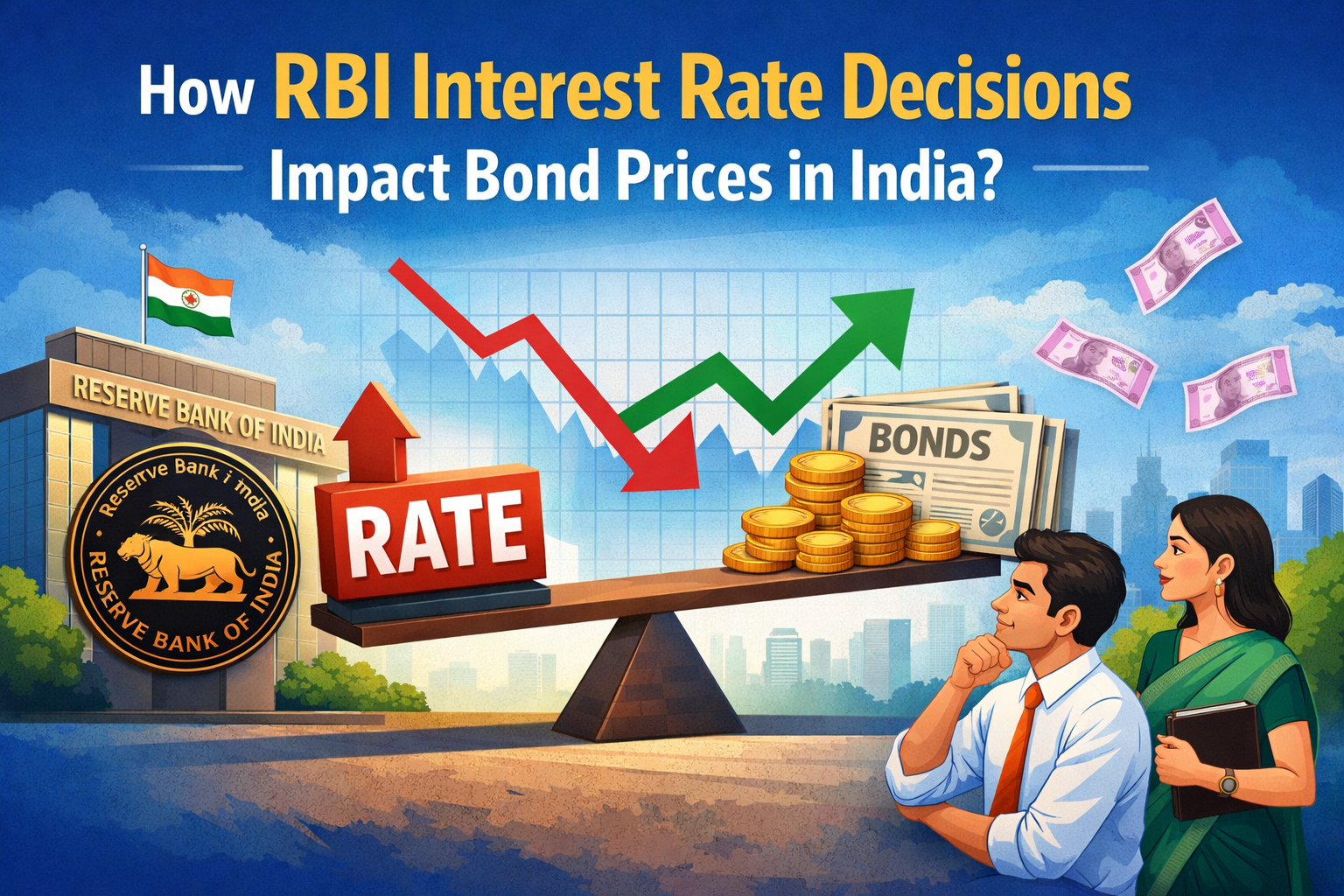
This is the core of the RBI interest rate impact on bonds. When the RBI raises rates, newly issued bonds offer higher yields, making existing bonds with lower coupons less attractive, which in turn lowers their prices. When rates are cut, existing bonds gain value. This relationship is especially visible in RBI bonds and corporate debt, making interest rate decisions crucial when buying or selling bonds in India.
Understanding the RBI’s Role in Interest Rates
When businesses assess borrowing costs, RBI announcements are often the first reference point. Bond investors watch these signals just as closely. The Reserve Bank of India plays a central role in setting policy interest rates that guide borrowing and lending across the economy.
These policy rates influence how banks price loans and deposits. Over time, they also shape the returns offered on fixed-income instruments such as bonds. When the RBI changes interest rates, it sends a clear signal to the market. A rate increase points to tighter borrowing conditions, while a rate cut suggests easier access to funds.
Bonds respond to these signals because their interest payments are fixed at the time of issuance. As market rates change, bond prices adjust to keep returns aligned with prevailing interest rates.
Understanding the RBI’s role helps investors interpret bond price movements as responses to policy decisions rather than as unexpected market noise.
How Interest Rates and Bond Prices Move Together?
Interest rates influence how bonds are priced in the market, even though their interest payments remain fixed.
- New bonds reflect the prevailing interest rate environment through their coupon rates.
- Existing bonds already have fixed coupons and cannot change their interest payments.
- To remain aligned with market returns, the prices of existing bonds adjust instead.
- Higher interest rates reduce the appeal of lower-coupon bonds, leading to lower market prices.
- Lower interest rates increase demand for higher-coupon bonds, pushing prices higher.
- Changes in investor demand reinforce these price movements in the secondary market.
This adjustment keeps bond prices aligned with prevailing interest rate conditions.
What Happens When RBI Raises Interest Rates?
An increase in RBI policy rates alters borrowing conditions across the economy and affects bond pricing.
- Newly issued bonds offer higher coupon rates to match the new interest environment.
- Existing bonds with lower coupons trade at lower prices to stay competitive.
- Investors often show a greater preference for shorter-maturity bonds during rising-rate cycles.
- Coupon payments on existing bonds remain unchanged despite price movement.
Rate hikes reshape bond pricing without altering the bond’s original promise.
What Happens When RBI Lowers Interest Rates?
Lower RBI policy rates signal easier borrowing conditions and influence bond prices accordingly.
- New bonds enter the market with lower coupon rates.
- Existing bonds with higher coupons become more attractive to investors.
- Increased demand leads to higher market prices for such bonds.
- Bonds with longer remaining maturity tend to show stronger price movement.
Falling rates generally provide support to bond prices across the market.
Impact on Different Types of Bonds
Interest rate movements affect all types of bonds, but the extent of impact varies by bond category.
- Government bonds closely track RBI policy decisions due to sovereign backing.
- Corporate bonds respond to both interest rate changes and issuer-specific factors.
- Credit quality, financial performance, and market perception influence price movement.
- The overall direction follows interest rate trends, while the magnitude differs.
Bond type plays an important role in shaping price behaviour during rate cycles.
Maturity and Sensitivity to RBI Decisions
The time remaining until maturity influences how strongly bond prices respond to interest rate changes.
- Long-term bonds are more sensitive to changes in interest rates.
- Small rate movements can lead to larger price changes in longer-maturity bonds.
- Short-term bonds typically experience smaller price fluctuations.
- Nearer maturities allow quicker adjustment to new rate conditions.
Maturity helps explain why some bonds move more sharply than others.
Must Read - Short-Term vs. Long-Term Bonds
How Investors Can Read RBI Signals?
Market participants closely follow the RBI's communication to understand the direction of interest rates.
- Policy statements provide insight into the RBI’s stance on inflation and growth.
- Commentary and economic indicators help interpret future rate trends.
- Market pricing often reacts to expectations before actual rate changes occur.
- Awareness helps investors contextualise bond price movements.
RBI signals influence market behaviour beyond the announcement day itself.
How to Buy RBI Bonds and Other Bonds in India?
Access to bonds has become more structured as regulated digital platforms have grown.
- Government and corporate bonds are issued with defined interest and maturity terms.
- SEBI-regulated platforms provide transparent access to bond information, with Bondbazaar offering a digital route for investors to explore and transact in bonds.
- Bonds are held in demat form, with interest and principal credited directly to the investor’s account.
- Secondary market access allows investors to buy and sell based on market conditions.
Simplified access allows investors to focus on strategy rather than process.
Why Liquidity Matters During Rate Changes?
Interest rate movements create price opportunities, but liquidity determines whether investors can act.
- Price changes matter only when investors can transact at the right time.
- Active secondary markets support timely entry and exit.
- Liquidity enables quicker response to RBI-driven market movements.
- Real-time trading access supports smoother participation.
Liquidity turns interest rate awareness into practical action.
Conclusion
RBI interest rate decisions continue to influence bond prices in a structured and predictable manner. While coupon payments remain fixed, market prices adjust based on interest rate direction, bond type, and remaining maturity. These movements reflect how fixed-income instruments respond to changing interest rate conditions over time. As participation in the bond market increases, access and liquidity have become important considerations for investors.
Bondbazaar, which allows investors to both buy and sell bonds on the same SEBI-regulated platform, supports participation across different interest rate cycles by enabling timely entry and exit.
Explore how interest rate cycles influence different bonds and compare options based on maturity, yield, and liquidity before making a decision.
Must Read - Why Are Bonds Called Fixed-Income Securities?
Frequently Asked Questions
1. How often do RBI interest rate decisions affect bond prices?
Bond prices react whenever RBI policy announcements or guidance signal a shift in interest rates. Even expectations of future changes can influence market prices.
2. Do all bonds react the same way to RBI rate changes?
No. While the overall direction is similar, the degree of price movement depends on factors such as maturity, coupon rate, credit profile, and bond type.
3. Are bond returns fixed even when prices change?
Yes. The coupon rate and principal repayment are fixed as per the bond terms. Market price changes only matter if the bond is bought or sold before maturity.
4. Is it better to invest before or after an RBI rate decision?
Investment timing depends on individual goals, holding period, and risk preference. Many investors focus more on maturity alignment than short-term rate movements.
5. Do interest rate changes affect holding bonds till maturity?
If a bond is held until maturity, interim price fluctuations do not affect the final principal repayment, provided there is no credit event.