

Market Linked Debentures (MLDs): Meaning, Types & Benefits
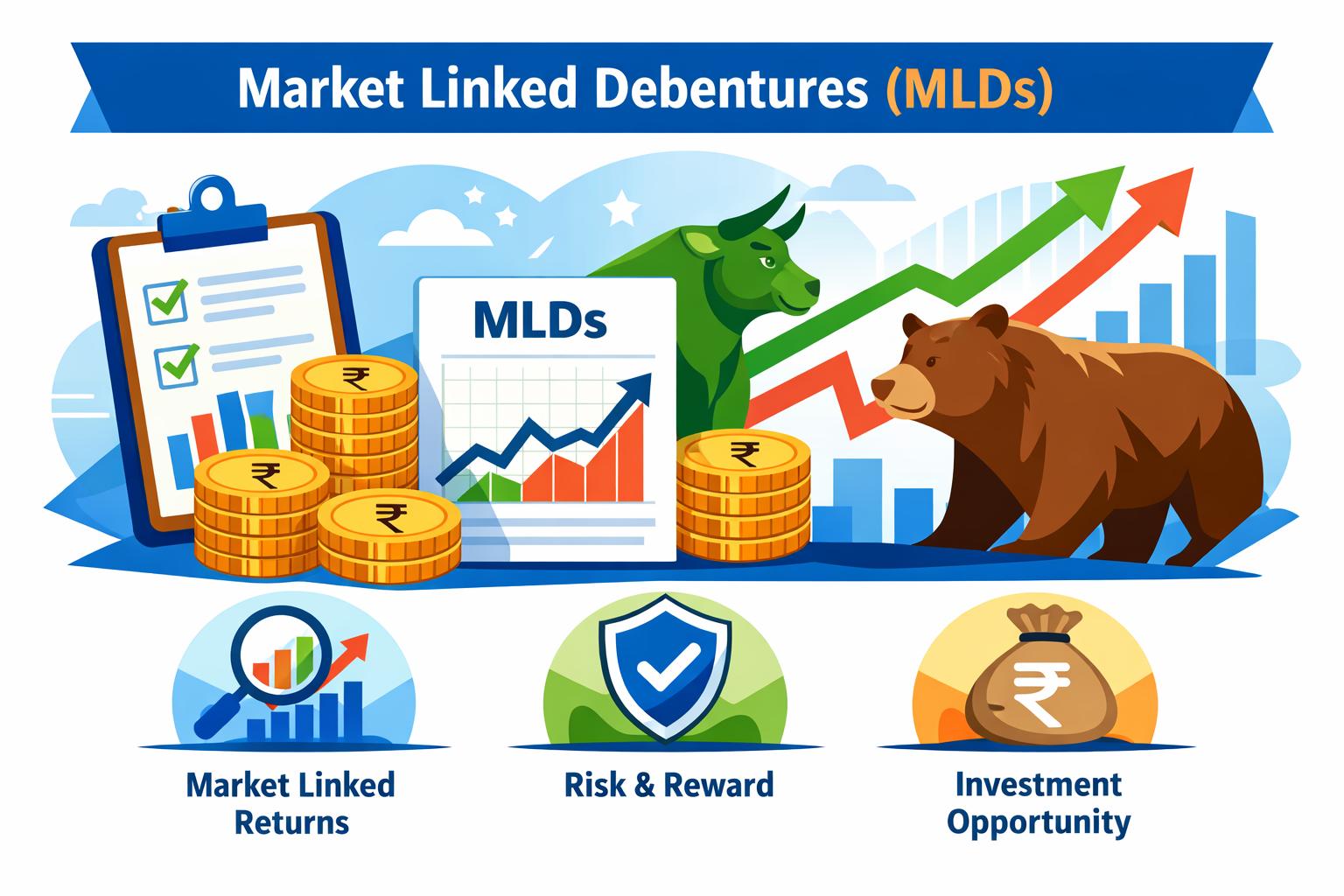
Market-linked investments, especially market-linked debentures, have become quite popular among investors seeking a mix of safety and growth potential. If you're exploring options that connect your investment to market performance and provide fixed or variable returns, understanding what MLD is, the types available, and their benefits can be beneficial.
What Are Market-Linked Debentures?
Imagine a business needs funds for expansion but wants to attract investors willing to take some risks with their capital for the potential of better returns. It issues bonds, debt instruments, that are not just repaid with interest, but whose returns are linked directly to the performance of a specific market index, such as the Nifty or the Sensex. These are known as market-linked debentures (MLDs).
Market-linked debentures are a unique type of bonds that blend the features of traditional bonds with the growth potential of market-linked investments. Companies or financial institutions issue them and offer a payout that depends on how a particular market index performs over the bond's tenure. Think of them as a partnership between a company seeking funds and the investor wanting exposure to market gains without directly investing in stocks.
The term "MLD full form" is simply "Market Linked Debenture". They are designed to provide investors with the benefits of market performance while offering a certain level of safety, often through features such as principal protection.
Types of Market-Linked Debentures
When looking at market-linked investments, including market-linked debentures, you will find different types based on how they handle risks and returns. The main categories are:
|
Type |
Description |
Risk Level |
Principal Protection |
|
Principal-protected MLDs |
These bonds promise to return your original investment amount at maturity, regardless of market performance. |
Lower risk |
Yes |
|
Non-principal protected MLDs |
The investment amount is at risk if the market performs poorly, but potential returns can be higher if the market does well. |
Higher risk |
No |
For example, a principal-protected MLD is like a savings plan that guarantees your initial money but offers a bonus based on market gains. Conversely, a non-protected MLD is like a riskier business venture, where your gains can be higher, but your original amount could be affected during market downturns.
Benefits of Investing in Market-Linked Debentures
Investors today want options that balance safety and the chance for good returns. Here’s where market-linked debentures shine:
- Potential for higher returns: Since the payout is linked to market index movements, investments can yield returns that surpass traditional fixed-income options, especially during bullish market phases.
- Diversification: These bonds allow investors to diversify their portfolios by indirectly gaining exposure to market performance, which can enhance overall asset balance.
- Downside protection: Many MLD options offer principal protection, meaning your original investment is safe even if the market doesn’t perform well.
- Tax efficiency: Depending on the structure, these bonds may offer favorable tax treatments in some scenarios.
- Flexibility: With various types available, investors can choose based on their risk appetite, investment horizon, and desired return profile.
How Do Market-Linked Debentures Work?
Think of it like an agreement with a company: if the market index performs well over the bond's tenure, the investor earns higher returns. But if the market underperforms, the principal safeguard in some types ensures the initial investment is protected, and returns may be limited or zero.
For example, if a company issues an MLD linked to the Nifty index with a five-year maturity, the pay-off depends on how the index performs at the end of this period. If it exceeds a certain threshold, the investor receives a higher payout, reflecting the market's rise. If not, they could get back their original principal, especially if they invested in a principal-protected structure.
Conclusion
Market-linked debentures (MLDs) blend safety with growth opportunities, making them an appealing choice for investors who seek to participate in market upsides without risking their entire principal. Understanding the different types and how they work helps investors align their investments with their financial goals and risk profile.
FAQs
Q1: What is the main aim of market-linked debentures?
They aim to offer investors the potential for higher returns linked to the market, combined with safety features like principal protection in some structures.
Q2: Are market-linked debentures safe investments?
They offer a balance of risk and reward; principal protection features make some MLD options relatively safe, but higher returns often come with increased risk. It's key to choose based on your risk appetite.
Q3: What are the risks involved?
Risks can include market volatility affecting returns, issuer credit risk, and, in non-protected variants, potential loss of principal if the market performs poorly.